A powerful and thought-provoking dialogue on the future of Africa’s rangelands took center stage on 26 March 2026 at a high-level blended-finance webinar that convened policymakers, development partners, private-sector actors, researchers, and community leaders, and attracted nearly 300 participants from 45 countries worldwide. Blended finance, an approach that combines public, private, and philanthropic capital to reduce investment risk and attract larger-scale funding, was at the heart of the discussions.
The webinar, hosted under the Herding for Health (H4H) Programme, an initiative of Peace Parks Foundation and Conservation International with partners including CCARDESA and GIZ, focused on a central challenge: while Africa’s rangelands are critical to livelihoods, food security, and climate resilience, they remain significantly underfinanced.
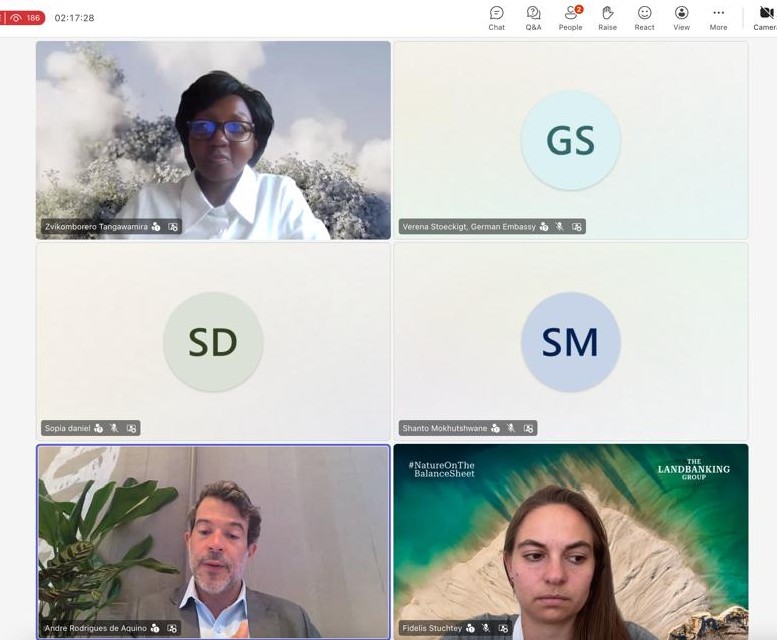
Opening the session, Moderator Ms. Zvikomborero Tangawamira, Senior Programme Manager for Herding for Health, highlighted the scale and urgency of the issue, noting that Africa’s rangelands support over 250 million people but are degrading at twice the global average. This degradation, she stressed, is not only an environmental concern but also a growing economic and social crisis. At the same time, she highlighted the potential of integrated approaches, such as Herding for Health, to address these challenges by linking animal health, ecosystem restoration, and community governance.
Throughout the discussions, a clear narrative emerged: rangelands are not failing systems; they are underinvested systems. Speakers emphasized that the current reliance on grant funding is insufficient to drive large-scale transformation and that new financing approaches are needed to unlock their full potential.
From a development partner perspective, Ms. Verena Stöckigt, Head of Environmental Affairs and Climate Action at the Embassy of the Federal Republic of Germany in Pretoria, highlighted the role of blended finance in bridging this gap. She explained that development partners play a critical role in providing early-stage funding and de-risking investments, thereby creating pathways for private capital to enter the sector. Drawing on Germany’s support through the International Climate Initiative, she emphasized that scaling restoration requires strong governance, credible data, and alignment with national development priorities.
Government perspectives reinforced the importance of policy alignment and national ownership. Representing Botswana, Mr. Bueno Shanto Mokhutshwane, GCF (FP158) Project Coordinator, outlined how the country is embedding rangeland restoration within national systems, linking it to livestock value chains, rural development, and economic growth. With communal rangelands supporting the majority of livestock production, Botswana’s approach demonstrates how restoration can be positioned as both an environmental and economic priority.
The conversation then shifted to what it would take to make rangelands truly investable. Dr. Fidelis Stuchtey of The Landbanking Group emphasized that attracting investment requires transforming rangelands into structured asset classes, supported by transparent verifiable data, clear economic returns, and robust legal frameworks. This was echoed in discussions on the importance of digital tools, such as satellite monitoring and traceability systems, in building investor confidence.
At the same time, speakers stressed that investment models must be grounded in community realities. Mr. Daniel Sopia, Chief Executive Officer of the Maasai Mara Wildlife Conservancies Association, highlighted that secure land tenure, inclusive governance, and equitable benefit-sharing are essential for ensuring that communities see value in rangeland investments. “True sustainability comes when communities are not just participants, but partners and decision-makers in rangeland investments.” He noted. Without these foundations, long-term sustainability cannot be achieved.
Insights from the private sector further demonstrated how blended finance can work in practice. Ms. Sarah Frazee of Meat Naturally shared experiences from livestock value chains, noting that resilience depends on diversification and a shift toward business-oriented approaches among farmers. By combining grant funding for initial system development with commercial investment for scaling, blended finance enables the growth of viable enterprises that can withstand climate and market shocks.
Mr. Lennart Hientz of the International Livestock Research Institute reinforced the need for integrated, system-wide approaches, highlighting that successful investment models must link restoration with value chains, certification systems, and additional revenue streams such as carbon markets and ecotourism.
Providing a global perspective, Mr. André Rodrigues de Aquino of the World Bank shared lessons from large-scale restoration efforts, particularly in China, where long-term policy alignment, clear land tenure, and public-private partnerships have enabled transformative results. “Large-scale restoration is possible when policy, financing, and land tenure systems work together; this is what we have seen in global examples such as China,” he noted. He further emphasized the importance of cross-sector partnership: “Public investment must go hand in hand with private sector engagement to create sustainable and scalable restoration outcomes.”
As the webinar concluded, a clear message emerged: Africa’s rangelands are not just ecological assets; they are economic opportunities waiting to be unlocked. However, realizing this potential will require a paradigm shift, from fragmented, grant-dependent interventions to coordinated, investment-driven approaches supported by strong policies, inclusive governance, and innovative financing. The momentum generated from this dialogue is expected to inform future investments, policy reforms, and collaborative action across the continent, paving the way for rangelands that are not only restored but also productive, resilient, and truly investable.
Several key action points emerged as participants emphasized the need to strengthen enabling policies and regulatory frameworks, improve data systems and investment metrics, and develop scalable blended-finance mechanisms to attract private-sector participation. There was also a strong call to enhance regional collaboration, knowledge exchange, and capacity building to support countries in transitioning from pilot initiatives to large-scale implementation.
Ultimately, the webinar sent a clear and compelling message: Africa’s rangelands are not just ecological assets; they are economic opportunities waiting to be unlocked. With the right mix of policy support, community engagement, and innovative financing, they can become resilient, productive, and investable systems that drive sustainable development across the continent.