
Germany is exploring ways to channel affordable European funding into African agriculture by enabling farmers to access markets directly.
This was revealed by Mr. Godfrey Marange during the launch of the Turmeric and Medicinal Herbs for a Prosperous Future programme, held recently at Desert Sands Hotel in Palapye.
Mr. Marange said the market for turmeric and medicinal herbs is vast, noting that local farmers have already responded positively. He added that plans are underway to invite the Minister of Lands and Agriculture to Germany to better assess demand and determine the required production volumes.
He explained that each farmer will be linked directly with a pharmaceutical company, as the produce will serve both the pharmaceutical and food industries in Germany. These companies will work directly with farmers, marking a new and more integrated approach to agricultural partnerships.
Mr. Marange further noted that farmers who have demonstrated passion and commitment are well-positioned to benefit from the affordable funding opportunities being introduced. With government support, he added, farmers will also gain access to grants aimed at strengthening capacity. However, as the initiative is still in its early stages, no local farmers have yet benefited.
Beyond turmeric, the programme targets approximately 30 other crops, including wild-harvested products such as baobab fruit. Mr. Marange emphasized that Africa possesses many of the resources Europe needs, but awareness remains limited. He concluded by referencing a biblical message: “My people perish for lack of knowledge.”
Meanwhile, Mr. Samuel Kealotswe, host of Gregos Turmeric Farm, said in an interview that their farming methods are fully organic. In addition to turmeric, they also grow birds-eye chili, habanero, and cayenne pepper.
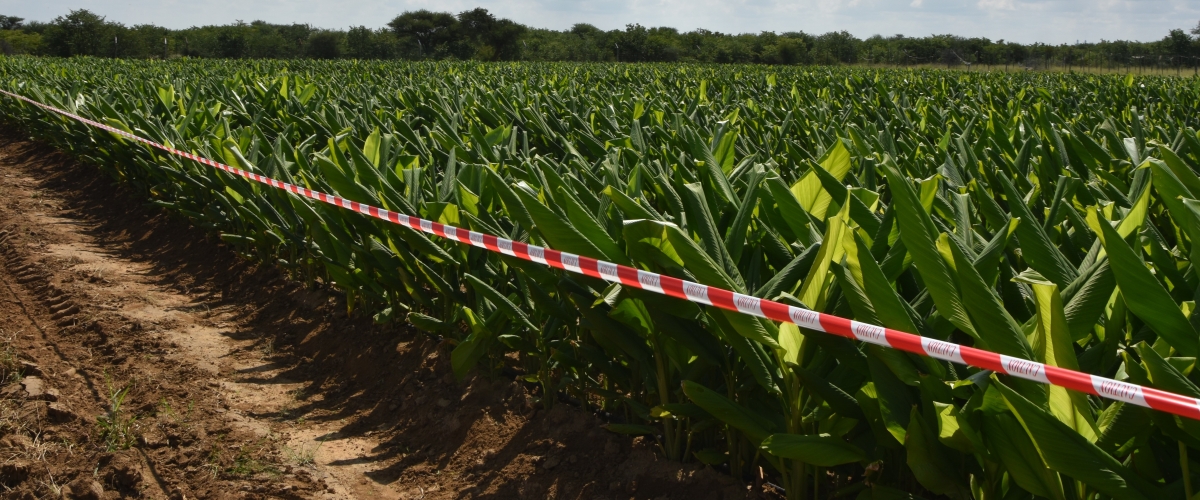
He explained that they use a product called Relic SEQ from Genesis, developed in Russia, which helps protect crops against frost and pests while improving overall plant health. “That is why when you look at our turmeric, it looks healthy,” he said, describing the product as powerful.
Mr. Kealotswe noted that their focus on turmeric is driven by demand in Europe, where it is used in products such as turmeric tea and turmeric coffee, as well as in pharmaceutical applications. He added that they are among the first turmeric farmers in the country and part of a group of just 24 farmers currently producing for export.
Encouraging broader participation, he said turmeric presents a strong investment opportunity with promising returns. He revealed that from the two hectares he has planted, he expects to generate around P9 million, with the potential for even higher returns due to the use of organic fertilizer from Russia.
Speaking at the event, Acting Minister of Lands and Agriculture, Dr. Edwin Dikoloti, described the initiative as more than just the introduction of a new crop.
“We are celebrating not just the introduction of turmeric cultivation, but a milestone that signals our nation’s resolute commitment to sustainable development and the empowerment of rural communities,” he said.
He noted that the initiative is spearheaded by Batswana agricultural experts, each bringing specialized knowledge to the programme. He added that efforts are ongoing to further strengthen the team in partnership with Global African Herbal Solution, a German company registered in Botswana.
Dr. Dikoloti said the partnership exemplifies the innovation and collaboration needed to drive the country forward. He described the organization as a pioneer in organic turmeric cultivation as a strategic export commodity, positioning Botswana on the global map as a leader in sustainable agriculture.
“This is a bold, timely, and inspiring initiative,” he said, adding that it encourages a forward-thinking approach to agriculture, one anchored in employment creation, generational wealth, and food security.
He emphasized that the project aligns with Botswana’s broader agricultural transformation agenda, aimed at building a diversified, resilient, and export-oriented sector. This, he said, will help achieve food security, reduce imports, and stimulate economic growth, while contributing to the country’s ambition of becoming a high-income, digitally enabled, export-driven economy.
The minister also highlighted that the project is national in scope and not confined to a single district. He recounted an anecdote from a farmer who observed that elephants avoided turmeric crops while consuming nearby sorghum, suggesting the plant may have natural repellent properties.
Dr. Dikoloti said this observation underscores the need for further research. He added that the initiative is a national effort driven by private sector champions, who have already mobilized 24 farmers out of 120 contracted across the country.
Currently, 22.3 hectares are under cultivation, with a projected harvest of approximately 892 tonnes between June and October 2026. He said the economic potential is significant, estimating that about 23 hectares could generate close to P100 million.
“We are just getting started,” he said, acknowledging that while challenges have been encountered, improvements are already underway.
The mobilisation of turmeric farmers has also created new employment opportunities, providing a lifeline for rural communities and boosting household incomes.
A representative of Batswana farmers from Global Gate Keepers, Dr. Patrick Mashiqa, said their company is collaborating with Global African Herbal Solution to educate local farmers about export opportunities in turmeric and other herbs.
He noted that last year, approximately 106 Batswana companies were contracted to grow turmeric. The current phase marks a second cycle, with more farmers being engaged across different regions of the country.
Dr. Mashiqa added that crops at the host farm are performing well, with plants reaching shoulder height, indicating strong growth and favorable conditions.
The author is the Sub Editor, Ministry of Lands and Agriculture (Botswana)