
"What resources do you already have in your rangelands?"
At first, the place was quiet.
Then the answers began flowing.
"Grass."
"Trees."
"Medicinal plants."
"Wild fruits."
"Firewood."
"Water."
One by one, farmers from Mangumbo Central, Lizwayi and Kabeti Zones began mapping the wealth hidden within their own rangelands. These are resources they have depended on for generations but had rarely viewed as the foundation of their future prosperity.
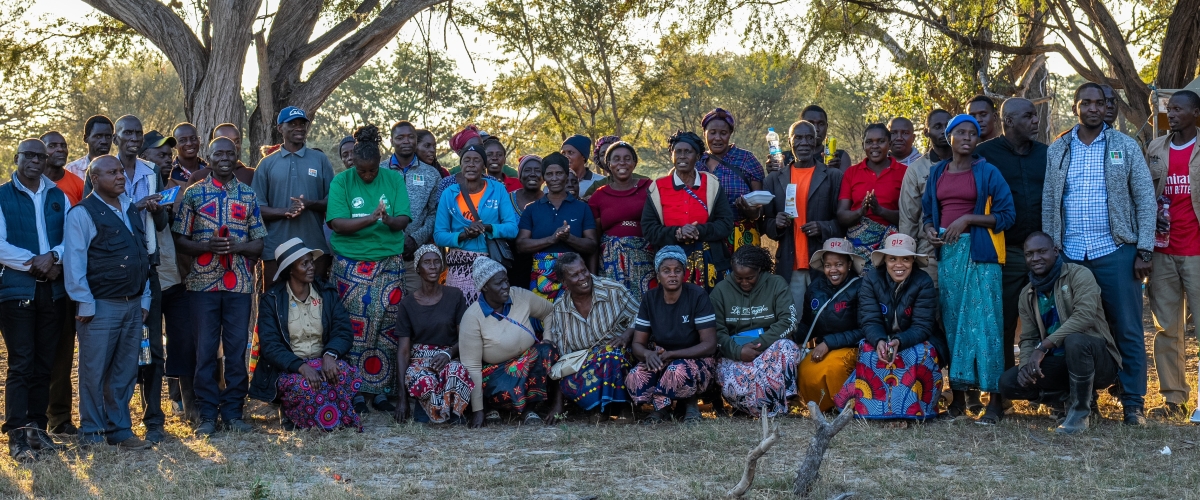
Organised by the Centre for Coordination of Agricultural Research and Development for Southern Africa (CCARDESA) under the Herding for Health (H4H) Knowledge Management Project, the training was conducted in partnership with Peace Parks Foundation and Conservation International (CI), in collaboration with the Deutsche Gesellschaft für Internationale Zusammenarbeit (GIZ) GmbH, with funding from the International Climate Initiative (IKI) of the German Federal Government. The program forms part of the Growing Greener Project, which seeks to restore degraded rangelands, improve livestock productivity, and strengthen climate resilience across Botswana, Madagascar, South Africa, and Zambia.
Rather than beginning with presentations, Dr Edmore Masaire, Herding for Health Technical Advisor from Peace Parks Foundation, challenged participants to reflect on the value of the natural resources surrounding them before exploring solutions to the challenges they face. The participatory exercise encouraged communities to appreciate that healthy rangelands are more than grazing areas, they are the backbone of food security, livelihoods and economic opportunity.
Mr Masiyaleti(Interpreter) and Dr Edmore Masaire (Facilitator)
As discussions unfolded, participants identified the many ecosystem services their rangelands provide, including pasture for cattle, browse for goats, construction grass, poles, medicinal plants, firewood, wild fruits, vegetables, mulch, shade trees, charcoal, materials for kraal construction and even traditional canoes.
Yet alongside this abundance came concern.
Community members openly described the pressures threatening their landscape, including prolonged droughts, declining pasture, uncontrolled veld fires, shrinking water sources and increasing livestock diseases. Many explained that goats have been dying because of water shortages, while poor grazing conditions continue to reduce livestock productivity and household incomes.
Despite these challenges, the atmosphere remained optimistic as participants shared what they hoped to gain from the training. Farmers expressed a strong desire to better understand climate change, improve fire management practices, strengthen grazing systems, establish and conserve fodder, and integrate goats and sheep more effectively into pastoral production systems. Many also emphasized the importance of continued follow-up support to help communities put the lessons into practice.
For many young people attending the training, the knowledge gained represents an investment in their future. "As young people, we see livestock farming as our future, but we need knowledge to manage our rangelands better," said Simushi Simushi, one of the youth participants. "This training is teaching us how to protect our grazing areas, improve our goats and sheep, and prepare for climate change. We now understand that taking care of the land means taking care of our livelihoods." Traditional leaders welcomed the participatory approach, saying it strengthened community ownership of natural resource management.
"Our rangelands are our wealth," said Mr Chrispin Mate, Traditional Chief of Namano Village. "They provide pasture, firewood, wild fruits, medicines and many other resources that sustain our people. If we fail to manage them well, future generations will suffer. We appreciate that this training respects our indigenous knowledge while introducing new practices that will help us conserve our land."
Women also highlighted the importance of healthy rangelands, noting that they often collect many of the natural resources that sustain rural households.
"Women depend on these rangelands every day," said Mrs. Monde Mulele, Chairperson of Mabumbu Cooperative. "We collect firewood, gather wild fruits, harvest grass for our homes, and care for the livestock. Learning how to conserve fodder and prevent uncontrolled fires will help us protect our families' livelihoods and ensure that our children inherit productive land."
One of the strongest messages to emerge from the training was that restoring degraded rangelands cannot be achieved by government or development partners alone. It requires communities to recognize the value of their natural resources, work collectively to prevent wildfires, adopt sustainable grazing practices, and improve livestock health.
As participants returned to their villages, they carried more than new technical knowledge. They left with a renewed appreciation for the fact that the future of their livestock, their families, and their communities depends on protecting the very land beneath their feet.
CCARDESA was represented by Dr. Bridget Kakuwa, Information, Communication and Knowledge Management (ICKM) Manager and Herding for Health Knowledge Management Project Lead, Ms. Botsang Mogotsi, Assistant Procurement Officer, and Ms. Kopo Letsebe, IT Support Officer.